When I Realized I Had ADHD (And What Changed)
For most of my life, I thought something was wrong with me. Not in a dramatic way. Just a quiet, nagging feeling that I was a little too much, a little too scattered, a little too hard to deal with. I...
For most of my life, I thought something was wrong with me. Not in a dramatic way. Just a quiet, nagging feeling that I was a little too much, a little too scattered, a little too hard to deal with. It took a friend basically shaking me by the shoulders to even consider that ADHD might be the explanation.
I Didn't Miss the Signs. I Was Just Told They Were Character Flaws.
Looking back, the signs were everywhere. In elementary school, I could hyper-focus on exactly one subject and have zero bandwidth for anything else. Teachers read that as not trying. My report cards probably said things like "doesn't pay attention" or "needs to apply herself." What was actually happening was that my brain had no interest in math and was completely locked into whatever did excite me. That's not laziness. That's ADHD.
I also cried a lot as a kid. I was emotionally all over the place and I had no framework for why. Neither did the adults around me. So instead of getting support, I got labeled as sensitive, dramatic, difficult. The emotional dysregulation piece of ADHD is so undertalked, and it was one of the heaviest parts of my childhood.
 0:30
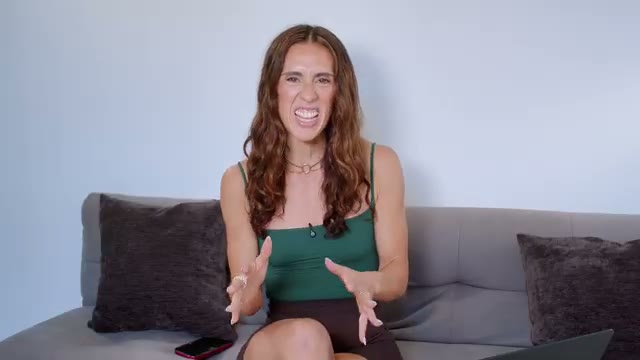
0:30 I even have this specific memory of hiding on the playground while everyone else went back inside, just to see if anyone noticed I was gone. That sounds strange out of context. But for a kid with ADHD who already felt like she didn't fit in, it made complete sense. I was looking for proof that I mattered. That someone would come looking. Those attention-seeking behaviors are real, and they make a lot more sense when you understand what's happening neurologically.
A Friend Said It Out Loud First
I was somewhere in my late 20s to early 30s when a friend looked at me and said, "You have ADHD." Just like that. Direct. And I started researching, reading everything I could find, watching videos, recognizing myself in every description. Then came the inevitable ADHD spiral of "Am I just convincing myself of this because I've been reading about it?"
I eventually got formally diagnosed through a neuroscience evaluation. And that diagnosis changed things. Not because I suddenly had all the answers, but because I finally had the right question. Instead of asking "what is wrong with me," I started asking "how does my brain actually work?"
What the Diagnosis Actually Changed
Getting diagnosed didn't fix anything overnight. But it gave me context for a lifetime of experiences that I had filed under personal failures. The struggles to stay organized. The racing thoughts that don't slow down even when I want them to. The way I can be completely checked out and running 100 miles an hour at the same time. I have combined-type ADHD, which means I got both the inattentive and hyperactive subtypes. Double whammy.
What it changed most was how I talk to myself. I stopped calling myself stupid. I stopped apologizing for how my brain moves. I started understanding that the same brain that makes it hard to clean a room is the same brain that built my business, that makes me a creative thinker, that makes me genuinely fun to be around. These things coexist.
Growing Up "Too Much" in a World Built for Quiet
Here's something I don't think gets said enough. A lot of women with ADHD spend years masking. We learn to shrink ourselves to fit into spaces that were never designed for us. School systems, workplaces, social expectations. We've been told to sit still, be quiet, don't be so opinionated. I spent a long time fighting my own instinct to speak up because voicing my opinion felt unacceptable. That kind of suppression doesn't come without a cost.
ADHD in women was barely studied for most of modern medicine. Most of the research was built around hyperactive young boys. So women who present as inattentive, who internalize instead of act out, got missed completely. Many of us were told we were anxious, or emotional, or just needed to try harder. We weren't diagnosed. We were dismissed.
Now, as an adult who's in therapy, who understands her brain, who has actual tools in her toolkit, things look different. Not perfect. Some days the dopamine is low and I'm in my emotional cocoon and I have to be honest with myself about where I'm at. But I know what's happening now. That knowledge matters more than I can explain.
What I Want You to Take Away From This
If you grew up feeling like you were too much, not enough, always just slightly outside the circle everyone else seemed to be standing in, I see you. That feeling has a name. And understanding it is not an excuse. It's a starting point.
ADHD is not a liability. It took me a long time to believe that. I'm still working on it. But the same traits that made school hard are the ones that make me good at my work, good at connecting with people, good at seeing things differently. The goal isn't to fix yourself. It's to understand yourself well enough to actually work with your brain instead of against it.
If you want to dig deeper into how ADHD affects your nutrition, your energy, your hormones, or your relationship with food, I would love to talk. Book a discovery call with me at wimn.co and let's figure out what your brain actually needs. You can also follow me for more real talk on ADHD, women's health, and performance nutrition.
FULL EPISODE
When I Realized I Had ADHD (And What Changed)
Want this for your specific situation?
The blog covers the patterns. Coaching is where we build something around you, your training, your brain, your life.